« Since 1896, the IOC has sought to uphold the neutrality of sport. Yet, this neutrality is more myth than reality. »
Lukas Aubin, Director of Research at the Institute for International and Strategic Relations (IRIS), in charge of the « Sport and Geopolitics » program
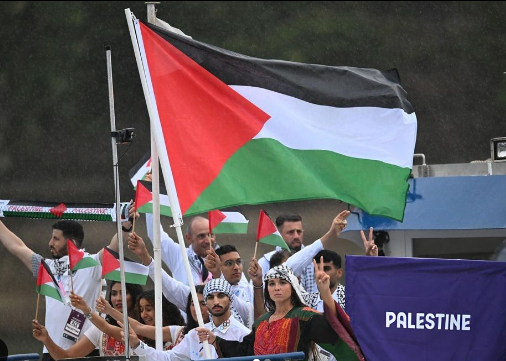
Palestinian Olympians in the 2024 Olympics
The debate over whether Israeli athletes should participate in the Paris 2024 Olympics has ignited considerable controversy. The backdrop is stark: over 37,000 deaths within seven months, with nearly 70% of the victims being women and children. This crisis has also deeply affected Palestinian athletes. Since October 7, 2023, 270 Palestinian Olympians have been killed, either directly or indirectly, by Israeli strikes.
Despite eight Palestinian athletes making it to the Olympics, the toll on Palestinian sports has been devastating. Approximately 400 athletes have lost their lives due to Israeli military actions in the past ten months, and 42 sports facilities have been damaged or destroyed. On July 22, the Palestinian Olympic Committee appealed to the International Olympic Committee (IOC) president to exclude Israel from the Games, citing violations of the Olympic Truce as Israel continued its attacks on Gaza during the Olympic period. The IOC’s rejection of this request has led to accusations of double standards, especially in light of Russia’s ban following the Ukraine conflict and South Africa’s suspension during apartheid.
The 2024 ICJ Advisory Opinion
On July 19, 2024, the International Court of Justice (ICJ) issued a historic advisory opinion declaring Israel’s occupation of Palestinian territories illegal, thus affirming Palestinian rights. The opinion condemns Israeli policies as violations of international law, including apartheid. Amnesty International has highlighted the severe suffering inflicted on Palestinians by this occupation. The ICJ has urged the international community to end the occupation and apartheid system, calling for Israel’s withdrawal from occupied territories and the lifting of the Gaza blockade. This advisory opinion follows the ineffective implementation of the 2004 recommendations regarding the separation wall, which had only reinforced Israeli impunity.
The History of Olympic Sanctions
The history of Olympic sanctions provides important context. South Africa was suspended from the Olympics from 1964 until the end of apartheid. More recently, Russia faced sanctions for violating the Olympic Truce during the Beijing Winter Olympics in 2022. Jean-Michel de Waele, a sports specialist, highlights the contradiction in the IOC’s stance. While the IOC officially opposes political interference, advocating for a ceasefire is inherently political, as is sanctioning athletes from specific countries like Russia.
Lukas Aubin, director of investigations at IRIS and a specialist in Russian geopolitics, underscores the IOC’s challenging position. The IOC’s 2022 request to exclude Russia recognized that sports can influence military politics. However, this decision has opened a Pandora’s box, as Aubin notes, because if the IOC acts against one country, it faces pressure to do the same for others, considering the numerous global conflicts, averaging around ten per year.
FIFA‘s history of sanctions is also instructive. The South African Football Association was suspended in 1961 due to apartheid policies. The Yugoslav team was suspended in 1992 following UN sanctions during the Serbian aggression in the Balkans. In 2022, the Russian team was suspended due to the invasion of Ukraine. However, Nazi Germany was not excluded from the 1938 World Cup, and the USA was not barred from the 2004 Athens Olympics despite its invasion of Iraq.
In 2016, FIFA adopted the UN’s Guiding Principles on Business and Human Rights, aiming to hold member associations accountable for violating these principles. This historical context is crucial for understanding the current #redcardisrael movement, yet Israel has not faced similar sanctions.
Given these precedents and the current geopolitical landscape, the IOC faces a dilemma: whether to maintain a consistent policy or risk accusations of double standards. The broader questions persist: Should the IOC sanction all nations involved in conflicts, or none? Should it engage in political matters at all?
Sources
FIFA must decide whether to ban Israel from competing in international football
@ajplusespanol ajplusespanol – Doble estándar en las Olimpiadas.
Israël, Palestine, Russie: la diplomatie sportive au cœur des JO de Paris 2024 | Slate.fr